When Hormuz reopens, How Quickly Could Gulf Oil Production Bounce Back?

Updated: Apr 28
On the morning of February 28, 2026, oil traders woke up to chaos. Overnight, the United States and Israel had launched airstrikes on Iran. Within hours, Iran responded by choking the Strait of Hormuz, the narrow artery through which nearly a fifth of the world’s oil flows.
Markets reacted instantly.
Brent crude jumped more than 50% in March from $71, briefly touching $120 per barrel. Even now, in late April, prices remain above $105.
For nearly two months, the world’s most important oil chokepoint has been effectively shut.
Now, with ceasefire talks underway, one question dominates:
If the Strait reopens, how fast does the oil come back?
Why the Gulf Matters More Than You Think
The Persian Gulf is not just another oil region. It is the backbone of global energy supply.
Saudi Arabia, Iraq, Iran, the UAE, Kuwait, and Qatar together drive about one-third of global seaborne oil trade. Around 20 million barrels per day flowed through the Strait before the crisis. Alternative routes are extremely limited. Only Saudi Arabia and the UAE can bypass Hormuz via pipelines, and their combined spare capacity is roughly 3.5 million barrels per day.
When Hormuz shuts, most oil simply cannot move.
Right now, about 14.5 million barrels per day is offline. That is roughly 57% of Gulf output and nearly 20% of global supply.
For context, the 1973 oil embargo removed about 6% of supply, and the Gulf War disrupted a similar amount. This is by far the largest oil shock in modern history.
What Happens When Oil Wells Shut Down
Oil wells are not light switches. When production stops for weeks or months, reservoir pressure begins to fall. As pressure drops, oil flow slows down and in some cases becomes unstable. Over time, sand and sediment can enter the wellbore, creating blockages that make restarting more difficult.
Bringing a well back online often requires what the industry calls a workover. This involves sending crews back into the well to clean out obstructions, restore pressure conditions, and stabilize flow. The longer a well remains shut, the more complex and time-consuming this process becomes.
Beyond the wells themselves, there is also a major logistical challenge. Tanker availability in the Gulf has dropped sharply during the crisis, and a large volume of oil is currently sitting in floating storage. Ships that were already loaded when the Strait closed are still waiting to leave. Until these barrels are cleared, new production cannot flow smoothly into the system. Even if the Strait reopens immediately, the recovery will not be instantaneous.

The Recovery Timeline
The recovery will not be uniform. Some countries can move quickly, while others will take longer.
Days to Weeks:
Saudi Arabia and the UAE are best positioned for a fast rebound. Many wells were not fully shut but instead operated at reduced flow. Their infrastructure is modern, well maintained, and supported by strong operational capabilities. Saudi Aramco has indicated it could ramp up production within days. Together, Saudi Arabia and the UAE could add more than 2 million barrels per day above pre-crisis levels.
Weeks to Months:
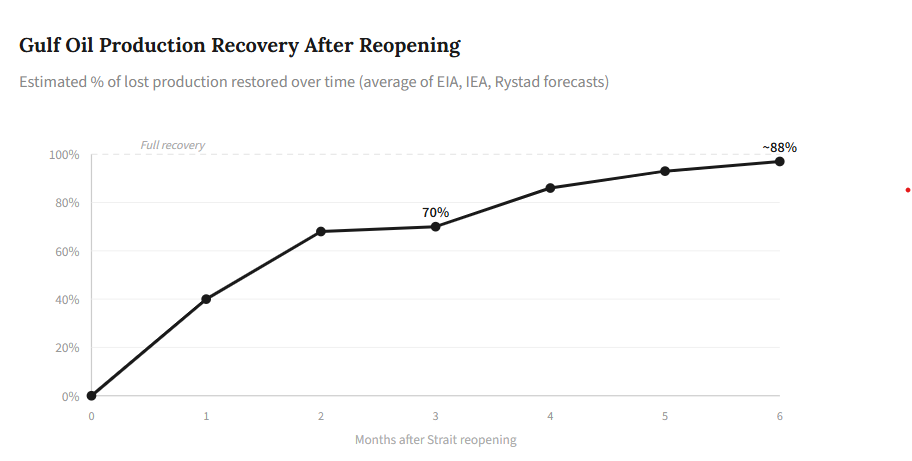
The rest of the Gulf Oil production will take longer to recover. Kuwait, for example, has indicated it could take three to four months to return to full output even if conditions stabilize quickly. Tanker bottlenecks, limited export capacity, and the need for field work will slow the pace of recovery. Most estimates suggest that around 70% of lost output could return within three months, rising to roughly 85 to 90% within six months.
Months and Beyond:
The final portion of production is the hardest to recover. The last 10 to 15% may take significantly longer and, in some cases, may not fully return. Iran faces challenges due to low-pressure reservoirs, while Iraq continues to deal with aging infrastructure and operational constraints. For these countries, recovery could stretch across multiple quarters.
What History Tells Us
History offers useful context for understanding how recoveries can unfold. In 2019, drone attacks on Saudi Arabia’s Abqaiq facility disrupted about 5.7 million barrels per day of production, roughly half of the country’s output. Despite the scale of the shock, production was largely restored within two weeks due to modern infrastructure and strong operational coordination.
A very different picture emerged in Libya after the 2011 civil war. Production collapsed from 1.6 million barrels per day to almost zero and took more than two years to recover. Political instability, damaged infrastructure, and ongoing disruptions slowed the process significantly.
The current crisis sits somewhere between these two extremes. Physical damage to oil fields appears limited, which supports the case for a relatively fast initial recovery. However, the length of the shutdown and the scale of logistical disruption introduce complexities that are likely to slow the overall pace.
What This Means for Investors
Oil shocks often feel chaotic in the moment, but they tend to follow a pattern. Supply disruptions push prices sharply higher, but those spikes usually ease as production returns.
A reopening of the Strait could trigger an immediate drop of $10 to $20 per barrel as speculative positions unwind. However, prices may remain elevated in the $80 to $90 range for some time due to lingering supply constraints and logistical bottlenecks.
Key things to watch include energy companies with upstream exposure, which stand to benefit from higher prices and the recovery phase. Oilfield services firms may also see increased demand due to the need for well work and maintenance.
Want to read more?
Subscribe to finsightsbysquareleague.com to keep reading this exclusive post.